

An online store is the kind of site where a server compromise hurts most: customer details, order data and payment flows all sit behind it. If your store runs on self-hosted PHP, such as WooCommerce, Magento or a custom cart, the October 2026 PHP flaws (CVE-2026-109618 and CVE-2026-109619, CVSS 9.2) deserve an emergency check today.
Hosted platforms such as Shopify run on the provider's own infrastructure, not on a PHP server you manage, so this particular PHP flaw is a concern for self-hosted stores.
The emergency audit checklist
- Confirm the PHP your store really runs. Check the build date in your hosting panel, or the package changelog on a VPS.
- Confirm the services restarted. On a VPS, PHP-FPM and queue workers must run the patched code.
- Check you are on a supported PHP version. PHP 8.1 and older receive no official fixes; PHP 8.2 security support ends December 31, 2026.
- Remove public
phpinfo()pages. They expose your server's internals. - Look for recently changed PHP files you did not deploy.
- Review cron jobs and admin users for anything you do not recognise.
- Search access logs for requests to
.gitand.env. A 200 response means a file was served. - Back up first, and keep a known-clean copy.
find /var/www/yourstore -name "*.php" -newermt 2026-10-01
zgrep -iE "\.git|\.env" /var/log/nginx/access.log*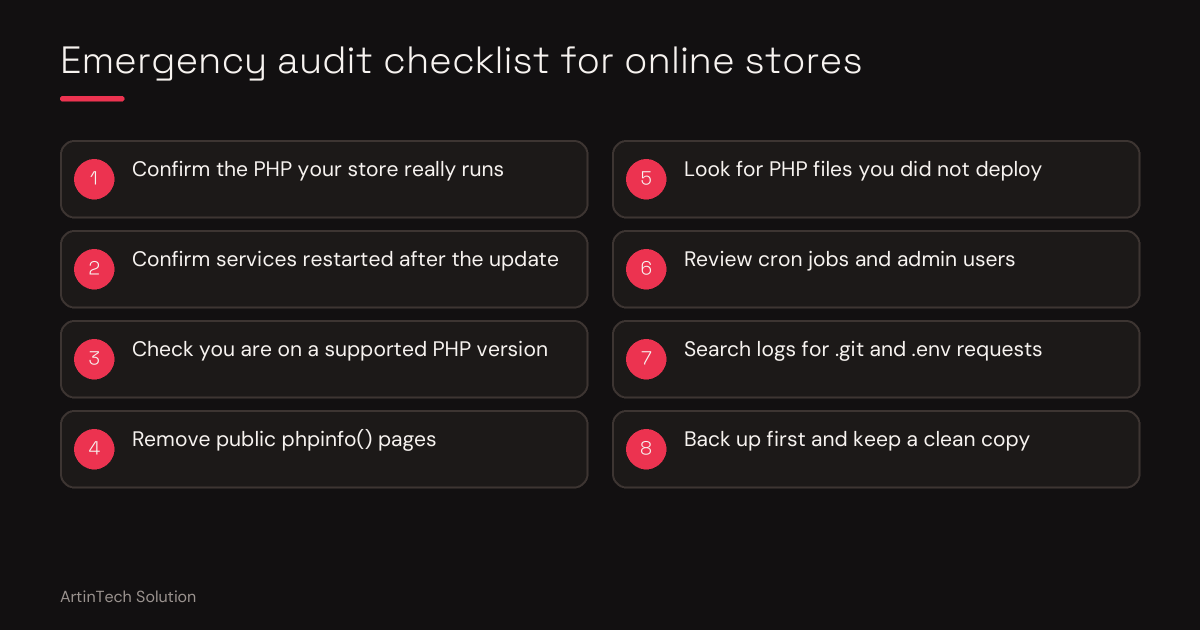
Why stores should not do this alone
A store cannot afford long downtime or a rushed fix that breaks checkout. Plugins and themes may not run on a newer PHP, and a wrong change on the live site costs sales. A proper audit tests changes on a staging copy first.
What ArtinTech Solution covers
- Server and PHP patch verification
- Safe PHP upgrades tested on staging, with checkout flows tested before go-live
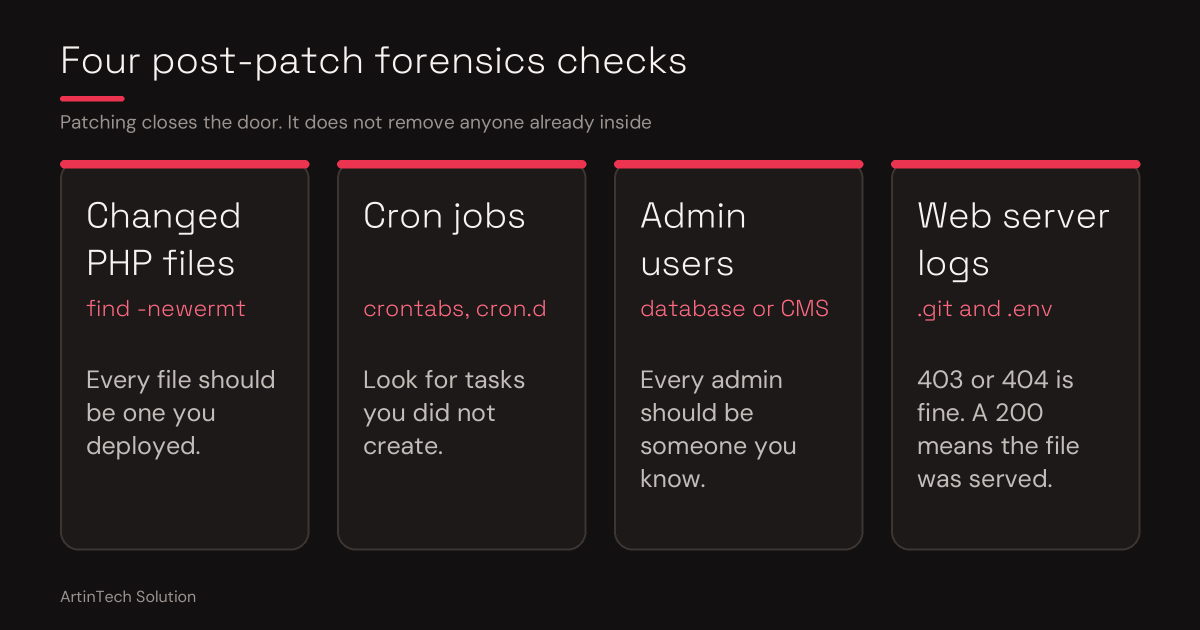
- Post-patch forensic checks for unknown files, cron jobs and admin users
- Rotation advice for passwords and API keys if anything looks exposed
See how we approach online stores in our e-commerce replatform case study.
Running a store on PHP? Hire ArtinTech Solution experts today for professional security audits, PHP upgrades, and emergency fixes.