
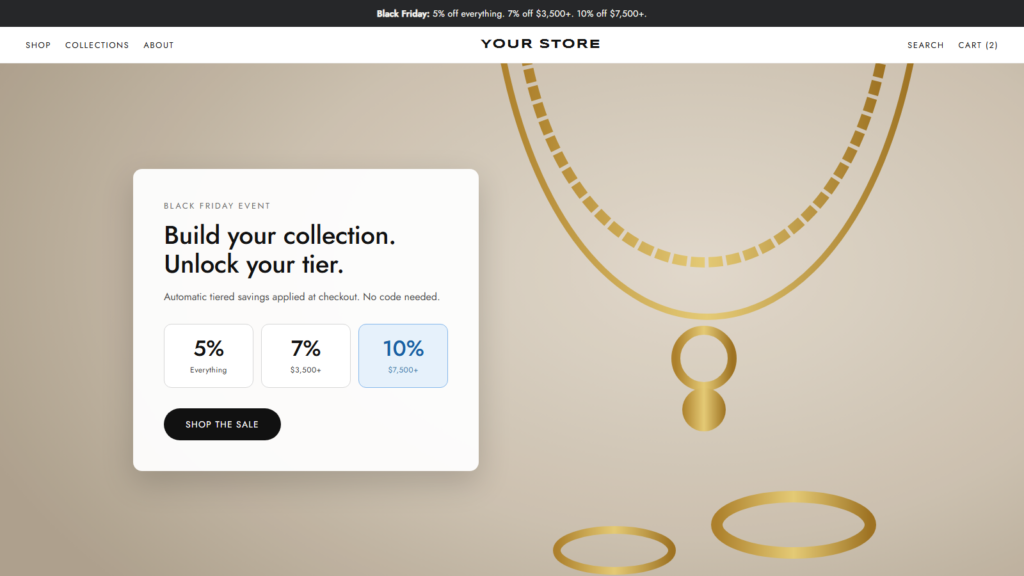
A flat “20% off everything” Black Friday sale is easy to launch, and just as easy for every competitor to copy. It also gives the same discount to the shopper buying one small item as to the one filling a basket. A tiered “spend more, save more” offer works differently: it rewards bigger orders, protects margin on small ones, and gives every shopper a clear reason to add one more item. Here’s how tiered Black Friday discounts work, why they influence buying behaviour, and why the way you build them on Shopify matters as much as the offer itself.
What is a tiered Black Friday discount?
A tiered discount raises the reward as the cart grows. A recent project we delivered for a luxury solid gold jewelry store used this structure:
- 5% off everything
- 7% off orders of $3,500+
- 10% off orders of $7,500+
Why offer a Black Friday discount at all?
- Shoppers are actively looking. Many customers plan purchases around Black Friday and compare stores that weekend. Without an offer, you may not make their shortlist.
- It moves undecided buyers. Shoppers who have browsed for weeks often need a reason and a deadline to buy now.
- It brings in new customers. A first order at a discount is a chance to win a repeat customer at full price later.
- It clears the path for the holiday season. Good Black Friday sales are often the start of gift orders through December.
Why tiered discounts can sell better than a flat discount
1. They give shoppers a goal
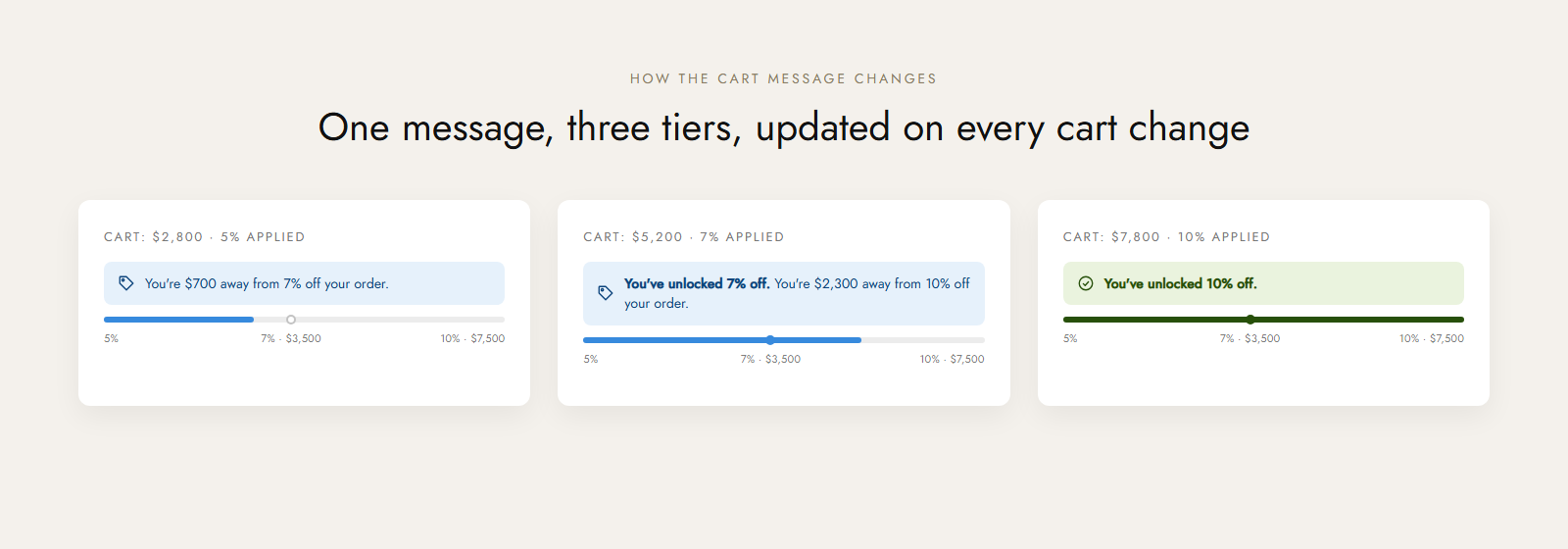
“You’re $700 away from 7% off” turns the cart into a progress bar. People tend to try harder as they get closer to a goal, so a visible target often encourages one more item instead of an abandoned cart.
2. They raise average order value where it matters
The bigger rewards only unlock at higher spend. That makes thresholds set slightly above your typical order value a natural nudge to add a matching chain, ring or second gift.
3. They protect your margin
Small orders get a modest discount; the deepest discount is reserved for the orders that can afford it. That’s a far better trade than giving everyone the same large percentage.
4. They make the offer feel personal
“You’ve unlocked 10% off” feels like an achievement, not a coupon. For luxury brands in particular, that tone fits better than a loud “everything must go” sale.
How to plan your tiers
- Start from your current average order value. Your first threshold should be reachable with one extra product, not three.
- Keep it to three tiers. More than that becomes hard to explain in a single banner.
- Check your margins at every tier. Make sure your best customers’ orders are still profitable at the top discount.
- Decide how it interacts with existing sales. Should items that are already marked down get the extra tier discount? Decide before launch, not after the first complaint.
- Measure the right numbers. Compare average order value, conversion rate and how many orders land in each tier against your last sale.
The real challenge: showing the offer at the right moment
Shopify can apply tiered discounts natively, but it won’t tell a shopper how close they are to the next tier. Without that message, the tiers are invisible exactly where shoppers make their decision: in the cart. That’s the gap our client asked us to close, and it’s where most stores need custom work.
Case study: a tiered Black Friday sale for a luxury jewelry store
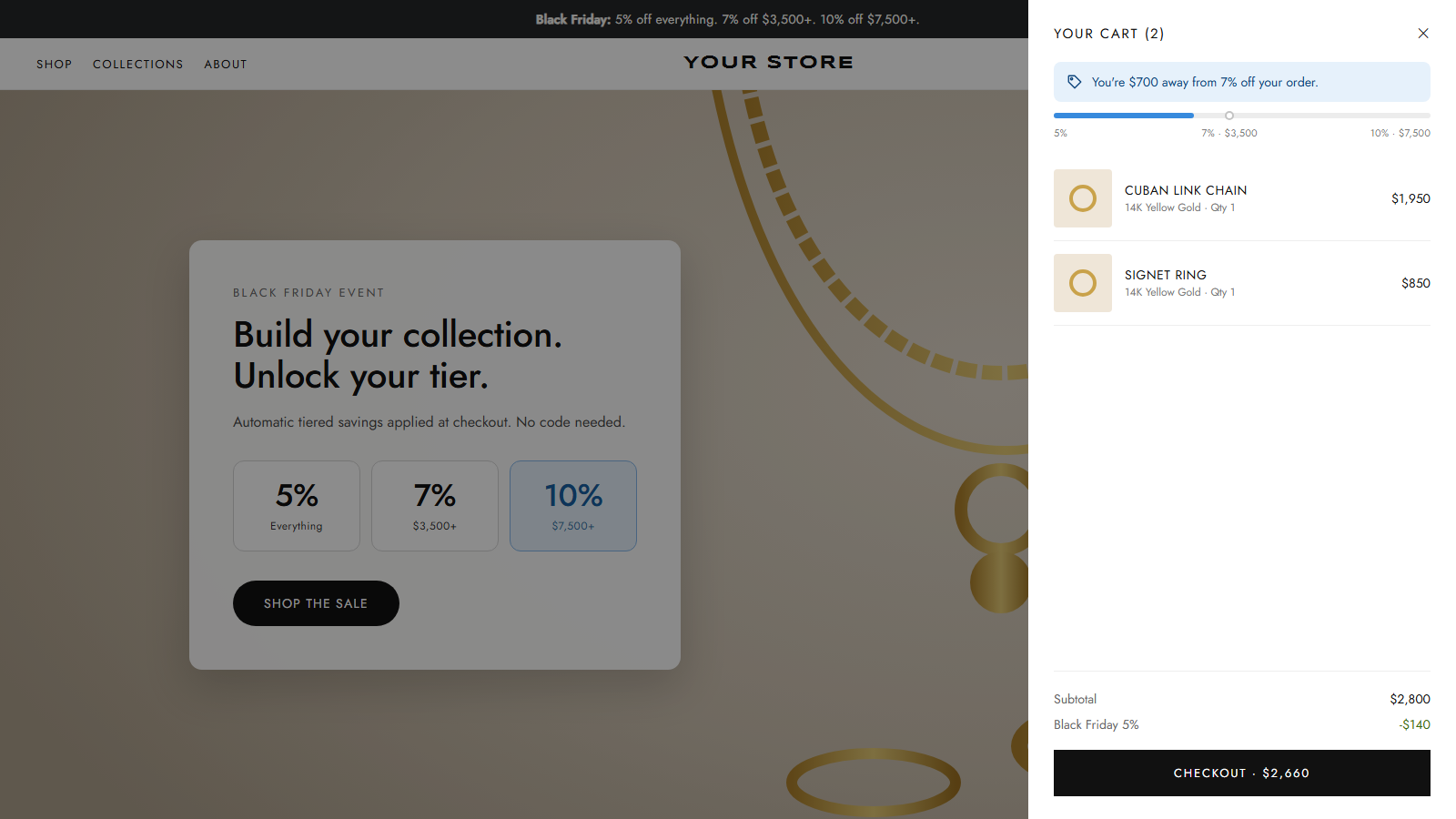
The challenge. The client wanted a banner, a cart message that changes as shoppers get closer to each tier, and the option to show savings in dollars. They were unsure whether this was possible without an expensive upsell app.
What we built. Using custom Shopify Liquid and CSS:
- Three automatic Shopify discounts, scheduled for the sale dates and set so they never stack.
- A cart drawer and cart page message with a progress bar that updates on every cart change.
- A choice of wording: “You’re $X away from 7% off” or “Add $X more and save $Y total”.
- A homepage hero section with background image, three tier cards, and full control over fonts, sizes and colours.
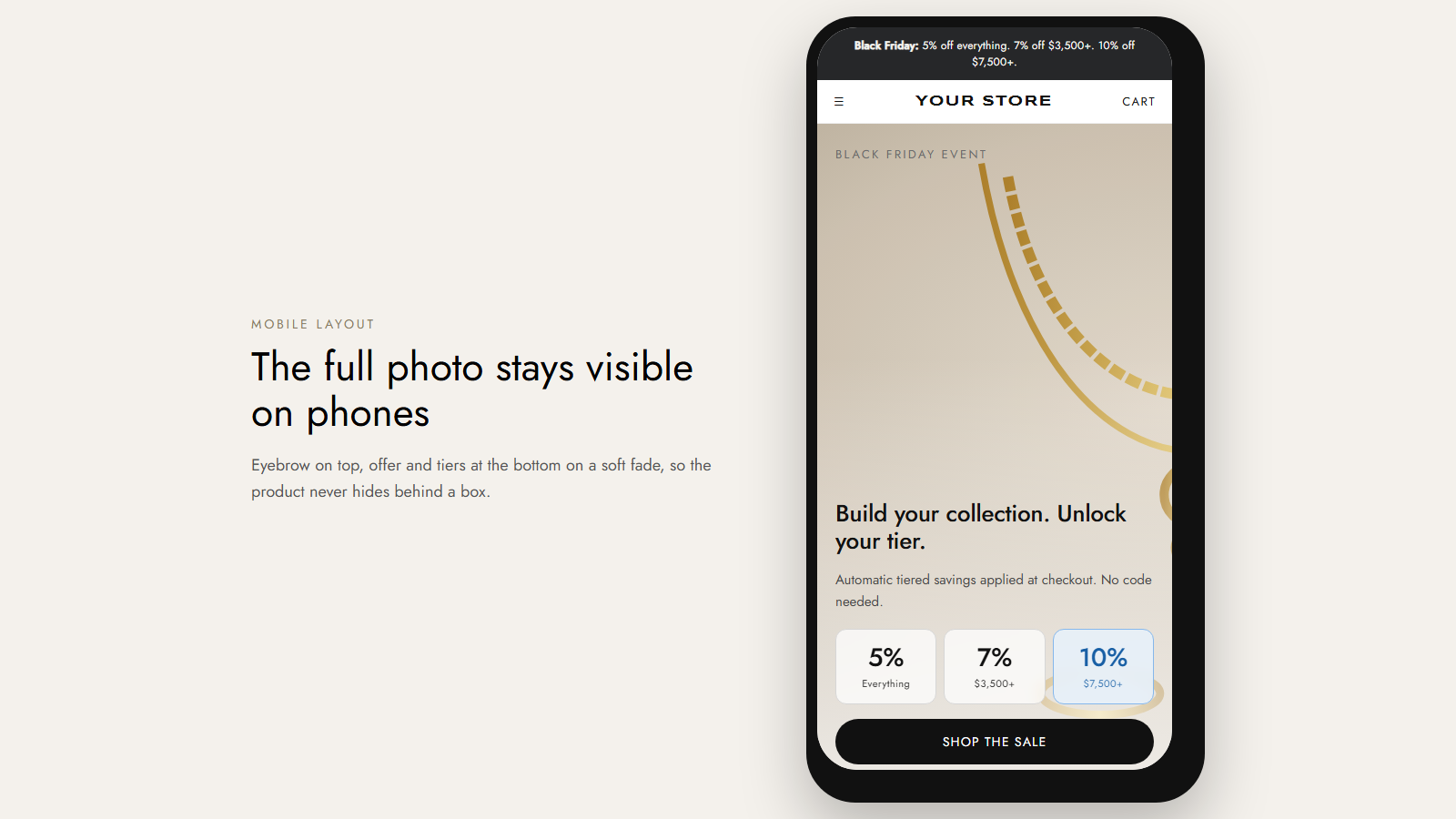
- Three mobile layouts, including one that keeps the full product photo visible.
- A settings panel so the store owner can change tiers, wording and colours without code.
How we protected the live store. Everything was built and tested on an unpublished copy of the theme. The discounts were created with a future start date, and checkout totals were verified with temporary test codes limited to one test account.
Upsell app or custom coding?
| Typical upsell app | Custom Shopify coding | |
|---|---|---|
| Cost | Monthly subscription, often tied to order volume | One-time project fee |
| Design | Generic widget, limited styling | Matches your brand exactly |
| Speed | Extra scripts loaded on every page | Rendered by your theme, minimal extra code |
| Flexibility | Limited to the app’s features | Built around your exact offer and edge cases |
| Ownership | Disappears if you cancel | The code stays in your theme |
Apps are a good fit for testing an idea quickly. For a store that runs promotions every year and cares about its brand and site speed, custom code usually pays for itself.
Why a custom Shopify coding service is worth it
- Your offer, not a template. Unusual thresholds, multiple currencies, excluded collections and special wording are all straightforward in code.
- Brand consistency. Fonts, spacing and colours match your theme, which matters for premium products.
- Faster pages. Less third-party JavaScript helps the store load quickly, especially on mobile during peak traffic.
- No surprises at checkout. The cart message uses the same subtotal rules as Shopify’s discount, so what shoppers see is what they get.
- Reusable. The same setup can run Cyber Monday, holiday and anniversary sales by changing a few settings.
Black Friday launch checklist
- Discounts created, dated and set not to combine.
- Theme thresholds match the discount minimums exactly.
- Banner, homepage section and cart messages checked on desktop and phone.
- Checkout totals tested at every tier.
- Existing discount codes reviewed for unwanted stacking.
- A plan for switching messages off when the sale ends.
Get your Black Friday offer built at a competitive price
We build tiered discounts, cart progress messages, custom homepage sections and other Shopify features using clean Liquid, CSS and JavaScript. Every project is tested on an unpublished theme before launch, so your live store is never at risk.
Ready to sell more this Black Friday? Message us with your store link and your offer idea. We’ll reply with a clear quote and timeline at a competitive price.
Frequently asked questions
What is a tiered discount?
A tiered discount increases the percentage off as the order total rises, for example 5% on any order, 7% over $3,500 and 10% over $7,500.
Do tiered discounts increase average order value?
They are designed to. By putting the bigger rewards just above a typical order, they give shoppers a reason to add another item. Measure average order value against a previous sale to see the effect on your own store.
Can I run a tiered discount on Shopify without an app?
Yes. Shopify’s automatic discounts can handle the tiers. Custom theme code adds the banner and the cart message that shows progress to the next tier.
How long does a custom setup take?
It depends on your theme and requirements. Message us with your store link and we’ll give you a timeline before any work starts.